Arnau Carballo

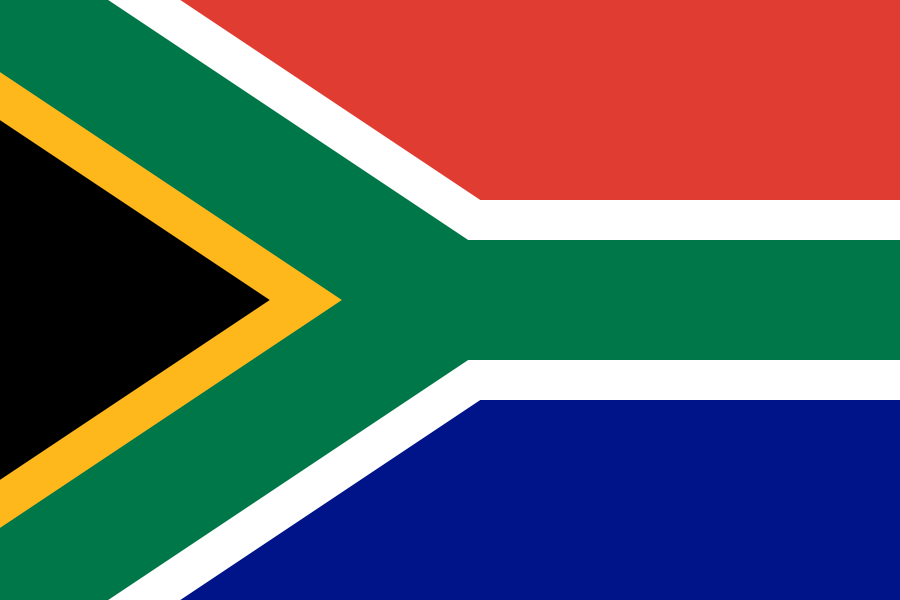
Flag:
The Republic of South Africa is a country located at the southern tip of Africa, with a 2,798 kilometres (1,739 mi) coastline on the Atlantic and Indian Oceans To the north lie Namibia, Botswana and Zimbabwe; to the east are Mozambique and Swaziland; while Lesotho is an independent country wholly surrounded by South African territory.
South Africa is known for a diversity in cultures and languages. Eleven official languages are recognised in the constitution. Two of these languages are of European origin: Afrikaans, a language which originated mainly from Dutch that is spoken by the majority of white and Coloured South Africans, and South African English. Though English has a large role in public and commercial life, it is nevertheless only the fifth most-spoken home language.
South Africa is ethnically diverse. About 79.5% of the South African population is of black African ancestry, divided among a variety of ethnic groups speaking different Bantu languages, nine of which have official status. South Africa also contains the largest European, Asian, and racially mixed communities in Africa. About a quarter of the population is unemployed and lives on less than US $1.25 a day. South Africa is the most populous country in the world to have legalised same-sex marriage throughout its entire territory.
South Africa is a constitutional democracy in the form of a parliamentary republic; unlike most parliamentary republics the positions of head of state and head of government are merged in a parliamentarily-dependent President. It is one of the founding members of the African Union, and has the largest economy of all the members. It is also a founding member of the United Nations and NEPAD. South Africa is a member of the Commonwealth of Nations, Antarctic Treaty System, Group of 77, South Atlantic Peace and Cooperation Zone, Southern African Customs Union, World Trade Organization, International Monetary Fund, G20 and G8+5.
History:
Within the country, anti-British policies among white South Africans focused on independence. During the Dutch and British colonial years, racial segregation was mostly informal, though some legislation were enacted to control the settlement and movement of native people, including the Native Location Act of 1879 and the system of pass laws. Power was held by the European colonists.
After four years of negotiating, the South Africa Act 1909 created the Union of South Africa from the Cape and Natal colonies, as well as the republics of Orange Free State and Transvaal, on 31 May 1910, exactly eight years after the end of the Second Boer War. The newly created Union of South Africa was a dominion of the British Empire. The Natives' Land Act of 1913 severely restricted the ownership of land by 'blacks'; at that stage they had control of a mere 7% of the country. The amount of land reserved for indigenous peoples was later marginally increased.
In the Boer republics, from as early as the Pretoria Convention (chapter XXVI), and subsequent South African governments, the system became legally institutionalised segregation, later known as apartheid. The government established three classes of racial stratification: white, coloured, and black, with rights and restrictions for each. In 1931 the union was effectively granted independence from the United Kingdom with the passage of the Statute of Westminster. In 1934, the South African Party and National Party merged to form the United Party, seeking reconciliation between Afrikaners and English-speaking "Whites". In 1939 the party split over the entry of the Union into World War II as an ally of the United Kingdom, a move which the National Party followers strongly opposed.
In 1948, the National Party was elected to power. It intensified the implementation of racial segregation begun under Dutch and British colonial rule, and subsequent South African governments since the Union was formed.The Nationalist Government systematised existing segregationist laws, classifying all peoples into three races, developing rights and limitations for each, such as pass laws and residential restrictions. The white minority controlled the vastly larger black majority. The system of segregation became known collectively as apartheid.
While the White minority enjoyed the highest standard of living in all of Africa, comparable to First World western nations, the Black majority remained disadvantaged by almost every standard, including income, education, housing, and life expectancy. The standard of living of the black majority was however higher than most African countries. On 31 May 1961, following a whites-only referendum, the country became a republic and left the Commonwealth. Queen Elizabeth II ceased to be head of state, and the last Governor-General became State President.
Despite opposition both within and outside the country, the government legislated for a continuation of apartheid. As the 20th century went on, Apartheid became increasingly controversial, some Western nations and institutions began to boycott doing business with the country because of its racial policies and oppression of civil rights leading to widespread international sanctions, divestment and growing unrest and oppression within South Africa. A long period of harsh suppression by the government, and at times violent resistance, strikes, marches, protests, and sabotage by bombing and other means, by various anti-apartheid movements, most notably the African National Congress (ANC), followed.
In the late 1970s, South Africa began a programme of nuclear weapons development. In the following decade, it produced six deliverable nuclear weapons.
The Mahlabatini Declaration of Faith, signed by Mangosuthu Buthelezi and Harry Schwarz in 1974, enshrined the principles of peaceful transition of power and equality for all, the first of such agreements by acknowledged black and white political leaders in South Africa, which would ultimately end with the negotiations between F.W. de Klerk and Nelson Mandela in 1993.
After years of internal protests, activism and insurgency by black South Africans and their allies, finally in 1990 the National Party government took the first step towards dismantling discrimination when it lifted the ban on the African National Congress and other political organisations. It released Nelson Mandela from prison after twenty-seven years' incarceration on a sabotage sentence. A negotiation process followed. The government repealed apartheid legislation. South Africa destroyed its nuclear arsenal and acceded to the Nuclear Non-Proliferation Treaty. South Africa held its first universal elections in 1994, which the ANC won by an overwhelming majority. It has been in power ever since. The country then rejoined the Commonwealth of Nations.
In post-apartheid South Africa, unemployment has been extremely high. While many blacks have risen to middle or upper classes, the overall unemployment rate of blacks worsened between 1994 and 2003. Poverty among whites, previously rare, increased. While some have attributed this partly to the legacy of the apartheid system, increasingly many attribute it to the failure of the current government's policies. In addition, the current government has struggled to achieve the monetary and fiscal discipline to ensure both redistribution of wealth and economic growth. Since the ANC-led government took power, the United Nations Human Development Index of South Africa has fallen, while it was steadily rising until the mid-1990s. Some of this could possibly be attributed to the AIDS pandemic and the failure of the government to take steps to address it.
Politics:
South Africa has three capital cities: Cape Town, the largest of the three, is the legislative capital; Pretoria is the administrative capital; and Bloemfontein is the judicial capital. South Africa has a bicameral parliament: the National Council of Provinces has 90 members, while the National Assembly has 400 members.
Members of the lower house are elected on a population basis by proportional representation: half of the members are elected from national lists and the other half are elected from provincial lists. Ten members are elected to represent each province in the National Council of Provinces, regardless of the population of the province. Elections for both chambers are held every five years. The government is formed in the lower house, and the leader of the majority party in the National Assembly is the President.
The primary sources of South Africa law are Roman-Dutch mercantile law and personal law with English Common law, as imports of Dutch settlements and British colonialism. The first European based law in South Africa was brought by the Dutch East India Company and is called Roman-Dutch law. It was imported before the codification of European law into the Napoleonic Code and is comparable in many ways to Scots law. This was followed in the 19th century by English law, both common and statutory. Starting in 1910 with unification, South Africa had its own parliament which passed laws specific for South Africa, building on those previously passed for the individual member colonies. During the years of apartheid, the country's political scene was dominated by figures like B. J. Vorster and P. W. Botha, as well as opposition figures such as Harry Schwarz, Joe Slovo and Helen Suzman.
Since the end of apartheid in 1994, South African politics have been dominated by the African National Congress (ANC), which has been the dominant party with 60–70% of the vote. The main challenger to the rule of the ANC is the Democratic Alliance party, which received 16.7% of the vote in the 2009 election and 14.8% in the 2006 election.
The formerly dominant New National Party, which introduced apartheid through its predecessor, the National Party, chose to merge with the ANC on 9 April 2005. Other major political parties represented in Parliament are the Congress of the People, which split from the ANC and won 7.4% of the vote in 2009, and the Inkatha Freedom Party, which mainly represents Zulu voters and took 4.6% of the vote in the 2009 election.
Since 2004, the country has had many thousands of popular protests, some violent, making it, according to one academic, the "most protest-rich country in the world". Many of these protests have been organised from the growing shanty towns that surround South African cities.
In 2008, South Africa placed 5th out of 48 sub-Saharan African countries on the Ibrahim Index of African Governance. South Africa scored well in the categories of Rule of Law, Transparency & Corruption and Participation & Human Rights, but was let down by its relatively poor performance in Safety & Security. The Ibrahim Index is a comprehensive measure of African governance, based on a number of different variables which reflect the success with which governments deliver essential political goods to its citizens.
After the end of apartheid in 1994, the "independent" and "semi-independent" Bantustans were integrated into the political structure of South Africa by the abolition of the four former provinces (Cape Province, Natal Province, Orange Free State and Transvaal Province) and the creation of nine fully integrated new provinces. The generally smaller size of the new provinces theoretically means that local governments have more resources to distribute over smaller areas. The provinces are subdivided into 52 districts: 6 metropolitan and 46 district municipalities. The district municipalities are further subdivided into 231 local municipalities. The metropolitan municipalities perform the functions of both district and local municipalities.
Geography:
South Africa is located at the southernmost region of Africa, with a long coastline that stretches more than 2,500 km (1,553 mi) and along two oceans (the South Atlantic and the Indian). At 1,219,912 km2 (471,011 sq mi), South Africa is the 25th-largest country in the world and is comparable in size to Colombia. Njesuthi in the Drakensberg at 3,408 m (11,181 ft) is the highest peak in South Africa.
The interior of South Africa is a vast, flat, and sparsely populated scrubland, the Karoo, which is drier towards the northwest along the Namib desert. In contrast, the eastern coastline is lush and well-watered, which produces a climate similar to the tropics.
To the north of Johannesburg, the altitude drops beyond the escarpment of the Highveld, and turns into the lower lying Bushveld, an area of mixed dry forest and an abundance of wildlife. East of the Highveld, beyond the eastern escarpment, the Lowveld stretches towards the Indian Ocean. It has particularly high temperatures, and is also the location of extended subtropical agriculture.
South Africa also has one possession, the small sub-Antarctic archipelago of the Prince Edward Islands, consisting of Marion Island (290 km2/110 sq mi) and Prince Edward Island (45 km2/17 sq mi) (not to be confused with the Canadian province of the same name).
Economy:
South Africa has a mixed economy with high rate of poverty and low GDP per capita. By UN classification South Africa is a middle-income country with an abundant supply of resources, well-developed financial, legal, communications, energy, and transport sectors, a stock exchange that ranks among the top twenty in the world, and a modern infrastructure supporting an efficient distribution of goods to major urban centres throughout the entire region. South Africa is ranked 25th in the world in terms of GDP (PPP) as of 2008.
Advanced development is significantly localised around four areas: Cape Town, Port Elizabeth, Durban, and Pretoria/Johannesburg. Beyond these four economic centres, development is marginal and poverty is still prevalent despite government efforts. Consequently the vast majority of South Africans are poor. However, key marginal areas have experienced rapid growth recently. Such areas include Mossel Bay to Plettenberg Bay; Rustenburg area; Nelspruit area; Bloemfontein; Cape West Coast; and the KwaZulu-Natal North Coast.
Unemployment is extremely high and South Africa is ranked in the top 10 countries in the world for income inequality, measured by the Gini coefficient. During 1995–2003, the number of formal jobs decreased and informal jobs increased; overall unemployment worsened. The average South African household income decreased considerably between 1995 and 2000. As for racial inequality, Statistics South Africa reported that in 1995 the average white household earned four times as much as the average black household. In 2000 the average white household was earning six times more than the average black household. The affirmative action policies, called Black Economic Empowerment, have seen a rise in black economic wealth and an emerging black middle class. Other problems are crime, corruption, and HIV/AIDS. South Africa suffers from relatively heavy overall regulation burden compared to developed countries. State ownership and interference impose high barriers to entry in many areas. Restrictive labour regulations have contributed to the unemployment malaise.
The 1994 government inherited an economy wracked by long years of internal conflict and external sanctions. The government refrained from resorting to economic populism. Inflation was brought down, public finances were stabilised, and some foreign capital was attracted. However, growth was still subpar. At the start of 2000, then President Thabo Mbeki vowed to promote economic growth and foreign investment by relaxing restrictive labour laws, stepping up the pace of privatisation, and cutting unneeded governmental spending. His policies face strong opposition from organised labour. From 2004 onward economic growth picked up significantly; both employment and capital formation increased.
South Africa is the largest energy producer and consumer on the continent. South Africa is a popular tourist destination, and a substantial amount of revenue comes from tourism. Among the main attractions are the diverse and picturesque culture, the game reserves and the highly regarded local wines.
The South African rand (ZAR), is the most actively traded emerging market currency in the world. It has joined an elite club of fifteen currencies, the Continuous linked settlement (CLS), where forex transactions are settled immediately, lowering the risks of transacting across time zones. The rand was the best-performing currency against the United States dollar (USD) between 2002 and 2005, according to the Bloomberg Currency Scorecard.
The volatility of the rand has affected economic activity, falling sharply during 2001 and hitting a historic low of 13.85 ZAR to the US$, raising fears of inflation, and causing the Reserve Bank to increase interest rates. The rand has since recovered, trading at 7.09 ZAR to the dollar as of Sept. 2010. However, as exporters are put under considerable pressure from a stronger domestic currency, many call for government intervention to help soften the rand.
Refugees from poorer neighbouring countries include many immigrants from the Democratic Republic of the Congo, Mozambique, Zimbabwe, Malawi and others, representing a large portion of the informal sector. With high unemployment levels amongst poorer South Africans, xenophobia is prevalent and many people born in South Africa feel resentful of immigrants who are seen to be depriving the native population of jobs, a feeling which has been given credibility by the fact that many South African employers have employed migrants from other countries for lower pay than South African citizens, especially in the construction, tourism, agriculture and domestic service industries. Illegal immigrants are also heavily involved in informal trading. However, many immigrants to South Africa continue to live in poor conditions, and the South African immigration policy has become increasingly restrictive since 1994.
Principal international trading partners of South Africa—besides other African countries—include Germany, the United States, China, Japan, the United Kingdom and Spain. Chief exports include corn, diamonds, fruits, gold, metals and minerals, sugar, and wool. Machinery and transportation equipment make up more than one-third of the value of the country’s imports. Other imports include chemicals, manufactured goods, and petroleum.
After unsuccessful attempts by the government to encourage private construction of power generation capacity, the state-owned power supplier Eskom started experiencing deficiency in capacity in the electrical generating and reticulation infrastructure in 2007. Such lack led to inability to meet the routine demands of industry and consumers, resulting in countrywide rolling blackouts. Initially, the lack of capacity was triggered by a failure at Koeberg nuclear power station, but a general lack of capacity due to increased demand has become evident since then. The supplier has been widely criticised for failing to adequately plan for and construct sufficient electrical generating capacity, although ultimately the government has admitted that it is at fault for refusing to approve funding for investment in infrastructure.
The crisis was resolved within a few months, but the margin between national demand and available capacity is still low (particularly in peak hours), and power stations are under strain, such that another phase of rolling blackouts is probable if parts of the supply are halted for whatever reason. The government and Eskom are currently planning new power stations. The power utility plans to have 20,000 megawatts of nuclear power in its grid by 2025.
Culture:
South African culture is diverse; foods from many cultures are enjoyed by all and especially marketed to tourists who wish to sample the large variety of South African cuisine. In addition to food, music and dance feature prominently.
South African cuisine is heavily meat-based and has spawned the distinctively South African social gathering known as a braai, or barbecue. South Africa has also developed into a major wine producer, with some of the best vineyards lying in valleys around Stellenbosch, Franschoek, Paarl and Barrydale.
The South African black majority still has a substantial number of rural inhabitants who lead largely impoverished lives. It is among these people, however, that cultural traditions survive most strongly; as blacks have become increasingly urbanised and Westernised, aspects of traditional culture have declined. Urban blacks usually speak English or Afrikaans in addition to their native tongue. There are smaller but still significant groups of speakers of Khoisan languages who are not included in the eleven official languages, but are one of the eight other officially recognised languages. There are small groups of speakers of endangered languages, most of which are from the Khoi-San family, that receive no official status; however, some groups within South Africa are attempting to promote their use and revival.
Members of middle class, who are predominantly white but whose ranks include growing numbers of black, coloured and Indian people, have lifestyles similar in many respects to that of people found in Western Europe, North America and Australasia. Members of the middle class often study and work abroad for greater exposure to the markets of the world.
Asians, predominantly of Indian origin, preserve their own cultural heritage, languages and religious beliefs, being either Christian, Hindu or Sunni Muslim and speaking English, with Indian languages like Hindi, Telugu, Tamil or Gujarati being spoken less frequently, but the majority of Indians being able to understand their mother tongue. The first Indians arrived on the famous Truro ship as indentured labourers in Natal to work the Sugar Cane Fields. There is a much smaller Chinese community in South Africa, although its numbers have increased due to immigration from Republic of China (Taiwan).
South Africa has also had a large influence in the Scouting movement, with many Scouting traditions and ceremonies coming from the experiences of Robert Baden-Powell (the founder of Scouting) during his time in South Africa as a military officer in the 1890s. The South African Scout Association was one of the first youth organisations to open its doors to youth and adults of all races in South Africa. This happened on 2 July 1977 at a conference known as Quo Vadis.
Religion:
According to the 2001 national census, Christians accounted for 79.7% of the population. This includes Zion Christian (11.1%), Pentecostal (Charismatic) (8.2%), Roman Catholic (7.1%), Methodist (6.8%), Dutch Reformed (6.7%), Anglican (3.8%); members of other Christian churches accounted for another 36% of the population. Muslims accounted for 1.5% of the population, Hindus about 1.3%, and Judaism 0.2%. 15.1% had no religious affiliation, 2.3% were other and 1.4% were unspecified.
African Indigenous Churches were the largest of the Christian groups. It was believed that many of these persons who claimed no affiliation with any organised religion adhered to traditional indigenous religions. Many people have syncretic religious practices combining Christian and indigenous influences.
Islam in South Africa constitute mostly of those are described as Coloureds and those who are described as Indians. They have been joined by black or white South African converts as well as others from other parts of Africa. South African Muslims claim that their faith is the fastest-growing religion of conversion in the country, with the number of black Muslims growing sixfold, from 12,000 in 1991 to 74,700 in 2004.
The Hindu population was primarily established during British colonial period, but later waves of immigration from India have also contributed to it. Most Hindus are ethnically South Asian but there are many who come from mixed racial stock, and some are converts with the efforts of Hindu missionaries such as ISKCON.
Languages:
South Africa has eleven official languages:[113] Afrikaans, English, Ndebele, Northern Sotho, Sotho, Swazi, Tswana, Tsonga, Venda, Xhosa and Zulu. In this regard it is third only to Bolivia and India in number. While all the languages are formally equal, some languages are spoken more than others. According to the 2001 National Census, the three most spoken first home languages are Zulu (23.8%), Xhosa (17.6%) and Afrikaans (13.3%). Despite the fact that English is recognised as the language of commerce and science, it was spoken by only 8.2% of South Africans at home in 2001, an even lower percentage than in 1996 (8.6%).
The country also recognises several unofficial languages, including Fanagalo, Khoe, Lobedu, Nama, Northern Ndebele, Phuthi, San and South African Sign Language. These unofficial languages may be used in certain official uses in limited areas where it has been determined that these languages are prevalent. Nevertheless, their populations are not such that they require nationwide recognition.
Many of the "unofficial languages" of the San and Khoikhoi people contain regional dialects stretching northwards into Namibia and Botswana, and elsewhere. These people, who are a physically distinct population from other Africans, have their own cultural identity based on their hunter-gatherer societies. They have been marginalised to a great extent, and many of their languages are in danger of becoming extinct.
Many white South Africans also speak other European languages, such as Portuguese (also spoken by black Angolans and Mozambicans), German, and Greek, while some Asians and Indians in South Africa speak South Asian languages, such as Tamil, Hindi, Gujarati, Urdu and Telugu. French is still widely spoken by French South Africans especially in places like Franschhoek, where many South Africans are of French origin. South African French is spoken by fewer than 10,000 individuals. Congolese French is also spoken in South Africa by migrants.